Fixing a Marshy Backyard in Whippany: A 1,500-Gallon Drywell for the Roof Drains
November 9, 2026 · Thomas N. Ott, PE · Drainage, Drywell, Stormwater, Groundwater Recharge
The homeowners in Whippany had a backyard they couldn’t use. After every rainstorm, the lawn stayed soft and marshy for days. They asked us to find out why and fix it.
The investigation
The first clue was the roof. Every downspout discharged straight onto the ground, so all the water from the roof landed in the yard.
Normally the soil would absorb that. To find out why it didn’t, we did a soil investigation. Just 2 feet below the surface, we found a thin layer of saturated clay. Clay lets water through very slowly. The roof water soaked into the topsoil, hit the clay, and had nowhere to go. It sat there until it evaporated, which is why the yard stayed wet for days.
Regrading or adding topsoil wouldn’t have fixed this, because the problem was underground. The roof water needed a way past the clay layer.
The design
We designed a 1,500-gallon drywell and routed all of the roof drainage into it through underground piping.
A drywell is a large precast concrete structure with perforated walls, set in a pit lined with filter fabric and surrounded by crushed stone. During a storm it fills with roof water and releases it gradually through its walls into the surrounding soil. Because it sits below the clay layer, the water drains into more permeable ground instead of pooling at the surface.
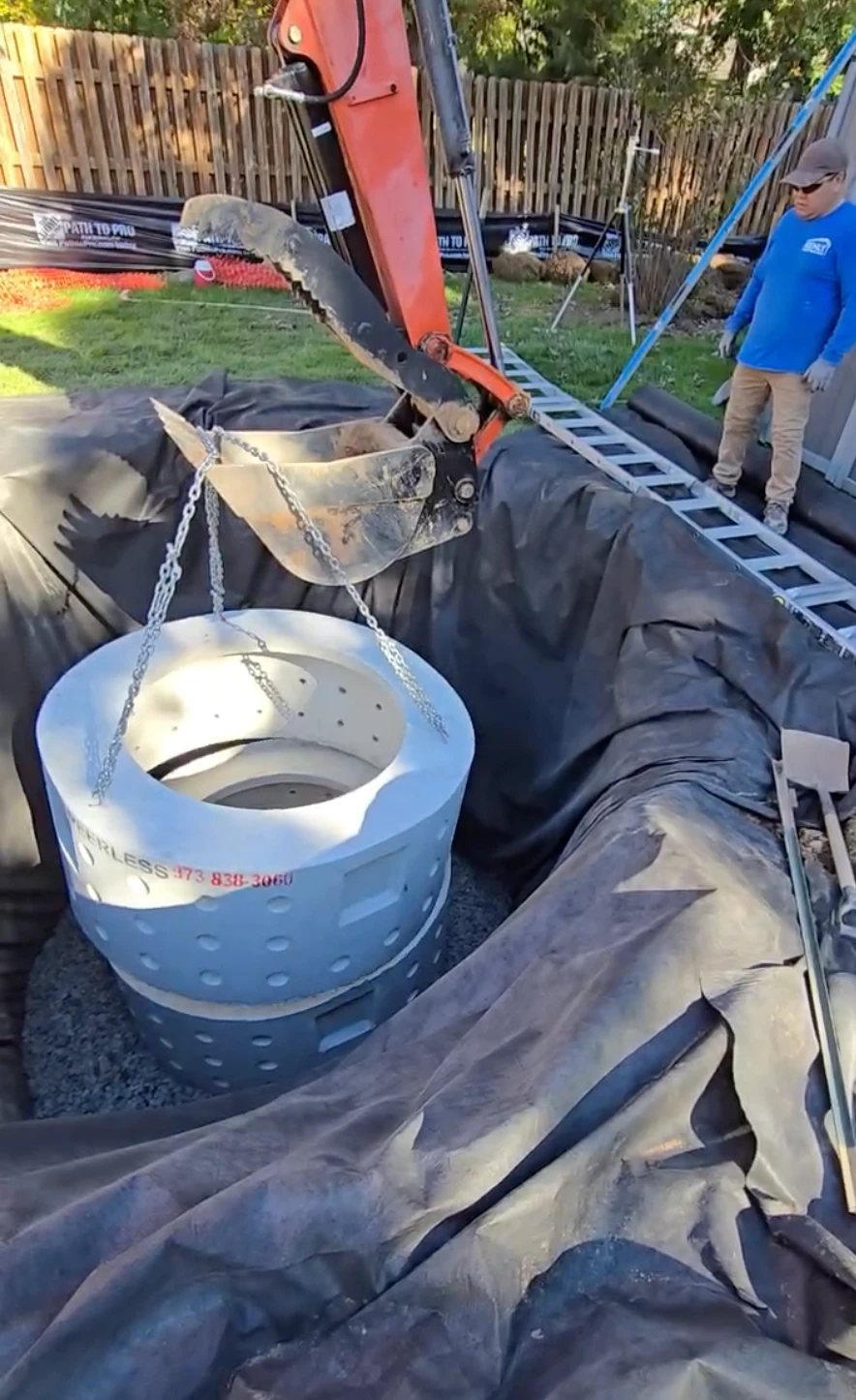
Installation: the perforated precast drywell rings going into a filter-fabric-lined excavation on a crushed stone base.
Sizing came from the roof area feeding it and the soil conditions we found during the investigation, so that the drywell can hold a storm’s runoff while it drains.
The result
- No more surface discharge. Roof water no longer lands in the yard, so the soil above the clay isn’t saturated after every rain.
- The water goes past the clay and into the soil below it, instead of sitting on top of it.
- It recharges the aquifer. The rainwater isn’t piped off-site to a storm sewer or stream. It goes back into the ground locally, which is what New Jersey’s stormwater rules encourage.
Is your yard staying wet after it rains?
Standing water and soggy lawns usually have a specific cause: a clay layer, a high water table, compacted soil, or downspouts discharging in the wrong place. A soil investigation finds which one, so you pay for a fix that works, not guesswork.
Learn more about grading and drainage → or get in touch with the address and a few photos.